

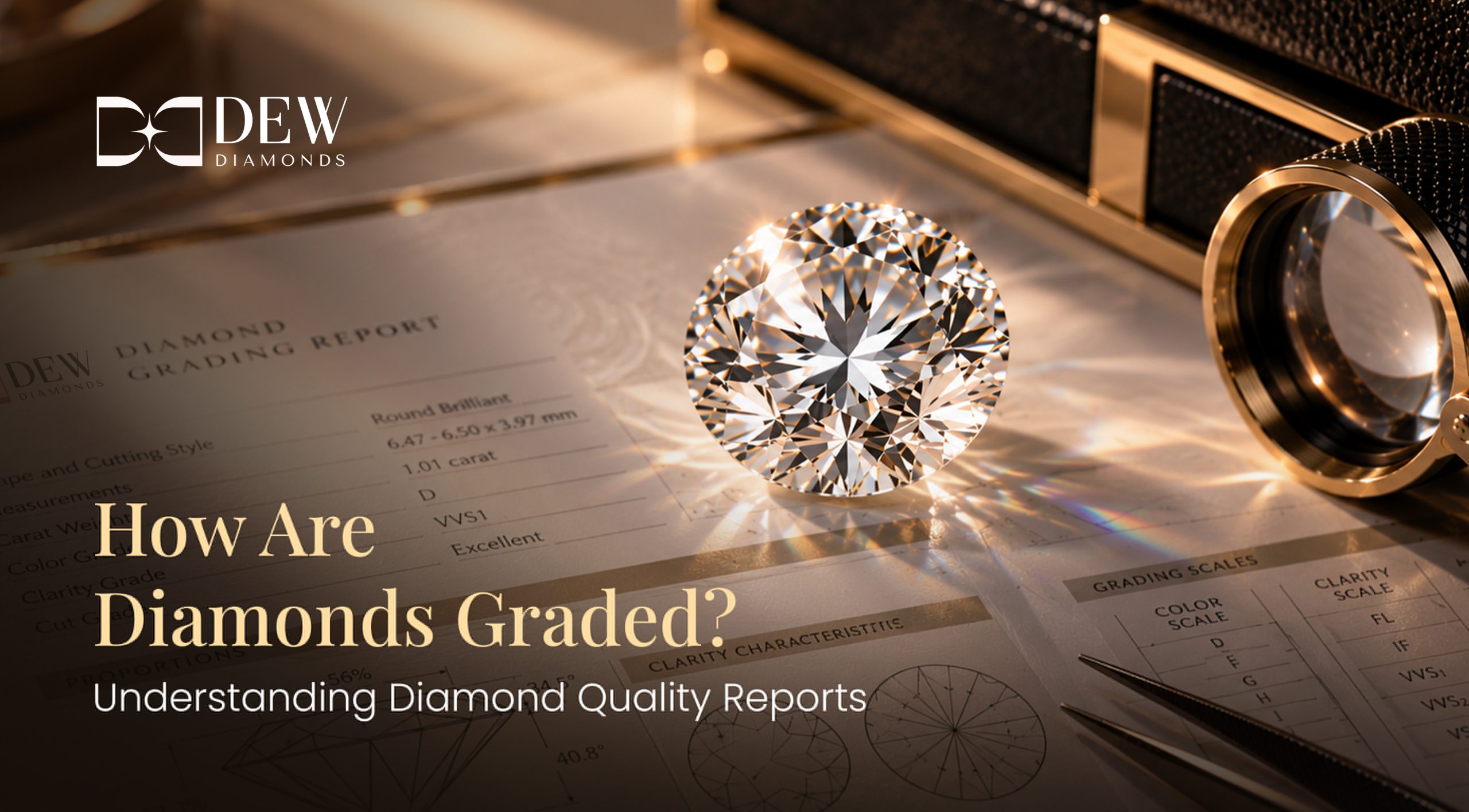
How Are Diamonds Graded? Understanding Diamond Quality Reports in Detail
Whether for a special occasion or as an act of self-love, diamonds often top the list of gifts to consider. Although diamonds are admired for their sparkle and beauty, several factors determine their quality and value.
Diamond grading involves evaluating a diamond’s characteristics and documenting its quality according to the laboratory’s applicable grading standards. In this blog, we will explain what diamond quality reports are, why they matter, the diamond grading process, the 4Cs of diamonds, and a lot more.
What Is a Diamond Grading Report?
A diamond grading report is a document issued by a gemological laboratory that evaluates and documents a diamond’s characteristics and quality according to the laboratory’s grading standards.
It describes the diamond and records grading factors such as the 4Cs: carat weight, colour, clarity, and cut, where applicable. Some reports also include a plotted diagram of the diamond’s clarity characteristics. Rather than being a certificate of value, a grading report documents the stone’s characteristics as evaluated at the time of examination.
Diamond grading reports are issued by gemological laboratories rather than individual jewellers or retailers. The following are some recognised laboratories that issue diamond grading reports:
- GIA (Gemological Institute of America)
- IGI (International Gemological Institute)
- HRD Antwerp (Hoge Raad voor Diamant)
- GCAL (Gem Certification & Assurance Lab)
- GSI (Gemological Science International)
How Is a Diamond Grading Report Different from a Receipt or Appraisal?
While a grading report describes the diamond’s quality and identifying characteristics, receipts and appraisals serve different purposes.
A receipt is a sales document that records details such as the purchase date, seller’s name, diamond description, and amount paid. An appraisal is a professional opinion of value issued by a qualified appraiser. It is a valuation based on factors such as the diamond’s quality, market conditions, and the purpose of the appraisal.
Both differ from a diamond grading report because neither is primarily intended to provide a laboratory assessment of the diamond’s physical characteristics. In simple terms, a grading report tells you about the diamond’s documented characteristics and quality, a receipt tells you what you paid, and an appraisal provides an opinion of value for a specific purpose.
Why Diamond Grading Reports Matter Before You Buy
Understanding a diamond’s quality is important before making a purchase. Rather than relying solely on a seller’s description, a diamond grading report provides an assessment of the diamond’s documented characteristics, helping you make a more informed purchasing decision.
The following are some reasons why diamond grading reports matter before you buy:
- Helps You Assess the Asking Price
Diamond prices depend on factors such as the 4Cs and other characteristics. A grading report provides a laboratory assessment of the diamond’s documented quality, helping you evaluate the asking price in relation to those characteristics. It also allows you to compare similar stones across different sellers.
- Helps Confirm the Diamond You Receive
A grading report helps you check whether the diamond you receive corresponds to the diamond examined by the gemological laboratory. Details such as the report number, carat weight, measurements, and grading characteristics can be checked against the report. This can help identify discrepancies between the documented diamond and the stone being purchased.
- Useful for Resale and Insurance
Diamond grading reports can also be useful for resale and insurance purposes. A report documents the quality and identifying characteristics of a diamond, making it easier to verify the stone’s details. The report can also provide documented information that may be useful when obtaining insurance or evaluating a diamond for resale. Depending on the purpose and requirements, additional documentation may still be needed.
- Builds Trust Between Buyers and Sellers
A standardised report documenting a diamond’s quality and characteristics provides buyers with information beyond the seller’s verbal description. It can help buyers verify the diamond’s reported characteristics and reduce uncertainty, making the purchasing process more transparent.
A Step-by-Step Look at the Diamond Grading Process
Diamond grading involves several stages, and the exact procedures vary between gemological laboratories and report types. The following steps outline the general process used to examine and document a diamond.
Step 1: Diamond Received at the Lab
Once the laboratory receives the diamond, it is logged into the system and assigned a unique identification or report number. The diamond is then examined and screened to determine whether it is natural or laboratory-grown and to identify evidence of treatments.
Step 2: Initial Measurements and Weight
The diamond is weighed using a precision balance to determine its carat weight. Its dimensions and proportions are also measured using appropriate instruments. These measurements form part of the information used to assess the diamond’s cut characteristics, where a cut grade is applicable.
Step 3: Cut Grade Assessment
Where applicable, the diamond’s cut is assessed using its proportions, measurements and other relevant characteristics. The laboratory then assigns a cut grade according to its specific grading criteria.
The exact cut-grading system varies by laboratory and diamond type. For example, GIA’s traditional cut grade applies to standard round brilliant diamonds in the D-to-Z colour range.
Step 4: Colour Grading Under Controlled Lighting
Colour grading is conducted under controlled viewing conditions to minimise the influence of external factors. For D-to-Z colour grading, the diamond is typically evaluated against established colour standards or master stones. The exact procedure varies by laboratory.
Step 5: Clarity Grading Under 10× Magnification
The diamond’s clarity is assessed at 10× magnification under standard viewing conditions. The grader examines inclusions inside the diamond and blemishes on its surface. Factors such as the size, nature, number, position, and relief of clarity characteristics are considered when assigning a clarity grade.
The GIA clarity scale contains 11 grades, from Flawless (FL) through Included grades I1, I2 and I3. Other laboratories may use their own grading procedures and terminology.
Step 6: Plotting Clarity Characteristics
Where a plotted clarity diagram is included, the laboratory uses a diagram representing the diamond’s shape and faceting style and marks relevant inclusions and blemishes on it. The resulting plot provides a visual record of the clarity characteristics documented during grading and can assist in identifying the diamond.
Step 7: Polish and Symmetry Evaluation
The polish and symmetry of the diamond are evaluated separately. Polish describes the quality of the diamond’s facet surfaces, while symmetry relates to the alignment and balance of its facets and overall shape. These characteristics are recorded as separate grades on applicable reports.
Step 8: Fluorescence Testing
The diamond can be exposed to long-wave ultraviolet (UV) radiation to observe its fluorescence. For GIA reports, fluorescence intensity is recorded as None, Faint, Medium, Strong, or Very Strong. When the fluorescence is Medium, Strong, or Very Strong, its colour is also recorded. Fluorescence is an identifying characteristic rather than one of the 4Cs.
Step 9: Laser Inscription of the Report Number
Where applicable, a laboratory may laser-inscribe the report number on the diamond’s girdle for identification. The microscopic inscription can be viewed under suitable magnification and compared with the report number. Some laboratories and report types have specific inscription requirements. For example, GIA’s laboratory-grown diamonds are laser-inscribed with identifying information.
Step 10: Report Issued and Diamond Returned
After the examination and grading results have been reviewed and finalised, the laboratory issues the grading report in the applicable format, which may be physical or digital depending on the laboratory and report type. The diamond is then returned according to the laboratory’s procedures.
The report may include the 4Cs, measurements, proportions, finish grades, fluorescence, treatments, identifying information, and, depending on the report type, a clarity plot, security features, or laser-inscription information.
The 4Cs on a Diamond Grading Report Explained
The 4Cs are carat weight, colour, clarity, and cut. Together, they describe important characteristics used to assess and communicate diamond quality. A grading report records these characteristics using the terminology and grading scales applicable to the laboratory and report type.
| Grade Factor | What It Measures | Scale Used |
| Cut | Light performance & proportions | Excellent → Poor |
| Colour | Presence of yellow/brown tint | D → Z |
| Clarity | Internal inclusions & surface blemishes | FL → I3 |
| Carat | Physical weight | Decimal (e.g., 0.50 ct or 1.00 ct) |
Note: Grading scales and terminology can vary by laboratory and report type. The Excellent-to-Poor cut scale and FL-to-I3 clarity scale shown here refer to the GIA grading system.
Understanding Diamond Colour Grades
The colour grade indicates the degree of colour present in a diamond. For diamonds graded on the D-to-Z scale, D represents the highest colour grade, while progressively lower grades indicate increasing yellow or brown colour. The appearance of a diamond can also be influenced by factors such as its shape, setting, lighting, and personal preference.
| Grade | Description | General Characteristics |
| D – F | Colourless | No noticeable body colour |
| G – I | Near Colourless | Very slight body colour |
| J – K | Near Colourless to Faint | Increasing body colour |
| L – Z | Faint to Light | Increasing yellow or brown body colour |
Understanding Diamond Clarity Grades
Diamond clarity refers to the relative absence of inclusions inside a diamond and blemishes on its surface. Clarity is assessed at 10x magnification, with graders considering factors such as the size, nature, number, position, and relief of clarity characteristics. The GIA clarity scale contains 11 grades, ranging from Flawless (FL) to Included (I3).
| Grade | Meaning |
| FL / IF | Flawless / Internally Flawless |
| VVS1 / VVS2 | Very, Very Slightly Included |
| VS1 / VS2 | Very Slightly Included |
| SI1 / SI2 | Slightly Included |
| I1 / I2 / I3 | Included |
The visibility of clarity characteristics to the naked eye cannot be determined solely from the clarity grade. It can vary according to the characteristics present, their location, the diamond’s shape and size, and viewing conditions.
Additional Details Found on the Grading Report
Beyond the 4Cs, a diamond grading report can include additional information that helps describe the diamond and verify its identity.
- Polish and Symmetry Grades: Polish indicates the quality of the diamond’s facet surfaces, while symmetry evaluates the alignment and balance of its facets and overall shape.
- Fluorescence: Records the diamond’s reaction to long-wave ultraviolet radiation. The intensity and, where applicable, colour of fluorescence are recorded according to the laboratory’s reporting system.
- Proportion Diagram: Provides a visual representation of the diamond’s proportions and measurements, helping document its cut characteristics.
- Laser Inscription Number: Where applicable, the report number or other identifying information may be microscopically inscribed on the diamond’s girdle, allowing the physical stone to be matched with its report.
- Security Features and QR Code: Depending on the laboratory and report type, reports may include security features or digital verification features such as QR codes. For example, GIA reports include security features and can be checked through GIA’s Report Check service.
IGI vs GIA vs SGL: Comparing Diamond Grading Reports
IGI, GIA, and SGL are gemological laboratories that issue diamond grading reports. Their report formats, grading services, terminology, and verification systems can differ. Instead of assigning a universal ranking, buyers should examine the laboratory’s grading information, the type of report issued, the diamond being graded, and whether the report can be independently verified.
- IGI
The International Gemological Institute, or IGI, issues reports for both natural and laboratory-grown diamonds. Its diamond reports document characteristics including carat weight, colour, clarity, cut, measurements, and origin. IGI also provides online report verification, allowing buyers to compare report information with its records.
For laboratory-grown diamonds, IGI states that its reports can include the growth method, such as CVD or HPHT, and information about post-growth treatments where applicable.
- GIA
The Gemological Institute of America, or GIA, is a gemological research and education institute that provides diamond grading and laboratory services. Its natural diamond reports document characteristics including the 4Cs, proportions, finish, treatments, and identifying information. Certain GIA reports also include a plotted clarity diagram.
GIA also provides laboratory-grown diamond services. Its laboratory-grown diamond reports use report formats and terminology specific to laboratory-grown diamonds and can include information about the growth type and post-growth treatment.
GIA provides an official Report Check service through which report information can be verified.
- SGL
Solitaire Gemmological Laboratories, commonly known as SGL, provides diamond grading reports. If a diamond is accompanied by an SGL report, buyers should review the information provided on the report and verify it through SGL’s official verification system before relying on the documented characteristics.
How Should You Compare Diamond Grading Reports?
No single report format applies to every diamond. When comparing reports, consider the following:
- Whether the laboratory clearly identifies the diamond as natural or laboratory-grown
- Which characteristics and grading factors are documented
- Which grading standards and scales are used
- Whether the report can be verified through the laboratory
- Whether the report includes relevant information about treatments or growth method
- Whether the report details correspond with the physical diamond
A grading report is an important source of information, but it is not a guarantee of a diamond’s market price or resale value. Buyers should also consider the diamond’s proportions, appearance, fluorescence, treatments, seller reputation, return policy, and asking price before making a purchase.
How to Verify a Diamond Grading Report Is Real
A diamond grading report should be verified through the issuing laboratory before relying on the information it contains. The report number, diamond details, and applicable security or identifying features should correspond with the laboratory’s records and the physical diamond.
- Check the Laboratory’s Official Website: Use the issuing laboratory’s official report verification service to confirm that the report number exists and that the recorded details match the report you have received.
- Match the Report Number to the Laser Inscription: If the diamond has a laser inscription on its girdle, check that the microscopic number matches the report number. The inscription can be viewed using suitable magnification.
- Use the Laboratory’s Online Verification Tool: Laboratories such as IGI and GIA provide online tools for checking their reports. Enter the report number through the laboratory’s official website and compare the displayed information with the physical report.
- Watch Out for Duplicate or Altered Reports: Be cautious if the report details do not match the laboratory’s online record, the report appears altered, or the diamond’s characteristics do not correspond with the documented information.
Grading Report for Natural Diamond vs. Lab-Grown Diamond: Is There a Difference?
Natural and laboratory-grown diamonds can both be evaluated for characteristics such as carat weight, colour, clarity, and cut. However, a grading report should clearly identify whether the diamond is natural or lab-grown because the origin of the diamond is an important part of its documentation. IGI reports, for example, identify natural or lab-grown origin.
The format and terminology used in the report can vary by laboratory and report type. For example, IGI provides separate reporting for natural and lab-grown diamonds, while GIA uses distinct services and report formats for these categories.
Laboratory-grown diamond reports can also include information about the growth method, such as CVD or HPHT, and any detected post-growth treatment, depending on the laboratory and report type.
Therefore, when reviewing a grading report, check the diamond’s origin, 4Cs or applicable quality assessment, measurements, treatments, and any additional comments relevant to that particular report.
Red Flags: When to Be Suspicious of a Diamond Grading Report
Not every difference between grading reports indicates a problem. Report formats vary between laboratories and report types, so the most important step is to verify the report through the issuing laboratory.
- Unknown or Unrecognised Laboratory Name: Be cautious if the issuing laboratory cannot be independently identified, its grading standards are unclear, or there is no reliable way to verify the report.
- Missing Clarity Plot Diagram: A missing plot is not, by itself, a red flag. Some legitimate grading reports do not include a plotted clarity diagram. For example, GIA’s Diamond Dossier includes a full 4Cs assessment but does not include a plotted diagram.
- No Laser Inscription on the Diamond: The absence of a laser inscription is not automatically suspicious because inscription practices vary between laboratories and report types. However, if the report states that the diamond has an inscription, the inscription should correspond with the report number and the issuing laboratory’s records. Any mismatch should be verified with the laboratory or an independent gemologist.
- Seller Refuses to Share the Report: A seller who refuses to provide the grading report or sufficient information to verify it should be approached with caution. Buyers should be able to review the documented characteristics and verify the report before making a purchase.
Checklist Before Accepting a Diamond Grading Report
Before accepting a diamond and its grading report, check the following:
- Issuing laboratory: Is the laboratory identifiable, and can the report be independently verified?
- Report number: Does the number appear in the laboratory’s official verification system?
- Diamond origin: Does the report clearly identify the diamond as natural or laboratory-grown?
- 4Cs: Do the carat weight, colour, clarity, and cut or applicable quality assessment match the seller’s description?
- Measurements: Do the measurements on the report correspond to the physical diamond?
- Clarity characteristics: If a clarity plot is provided, do the plotted characteristics correspond to the stone?
- Laser inscription: If applicable, does the inscription on the diamond match the report number?
- Treatments and comments: Check whether any treatments, growth method, or other relevant information has been disclosed.
- Report security: Check the report’s security and verification features where applicable.
- Physical diamond: Make sure the actual diamond corresponds to the report before completing the purchase.
Explore Exquisite Diamond Collection at Dew Diamonds
A diamond grading report provides important information about a diamond’s identity, 4Cs, and other characteristics such as proportions, polish, symmetry, fluorescence, and treatments. Knowing how to read these details and verify the report helps you compare diamonds more confidently and check whether the stone corresponds to its documented characteristics. Whether you are considering a natural or laboratory-grown diamond, reviewing its report carefully can help you make a more informed purchase.
At Dew Diamonds, we bring our expertise in diamond jewellery manufacturing to a range of jewellery designs, including rings, necklaces, earrings, bangles and pendants. We also offer custom jewellery options through our Build Your Own Diamond Jewellery service, helping you explore jewellery created around your requirements. Explore our diamond jewellery and find a design that feels right for you.
