How CAD and CAM Technology Is Used in Diamond Jewellery Making
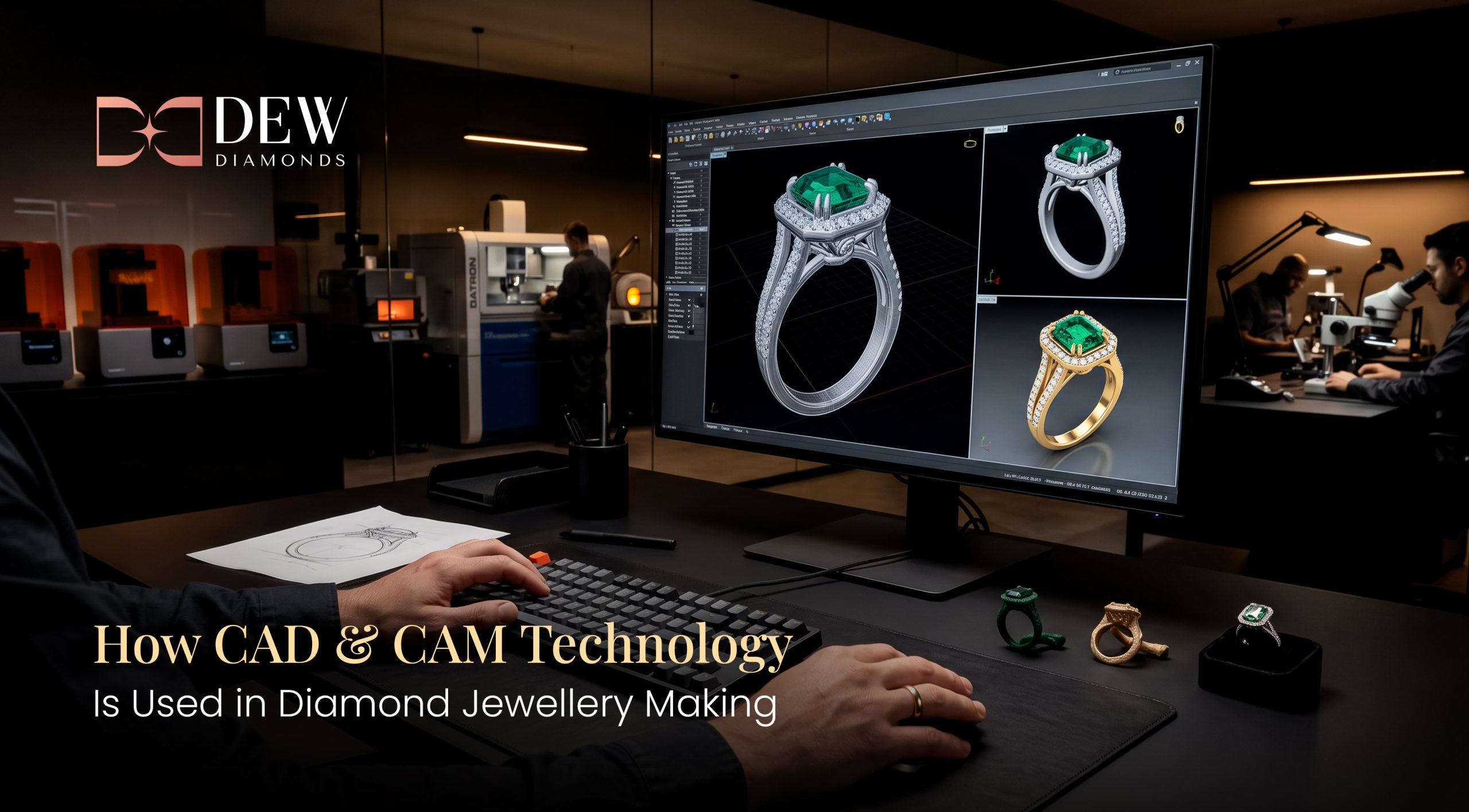
Every piece of diamond jewellery starts with an idea. In many cases, that idea begins as a hand sketch before moving into digital design. CAD jewellery design allows designers to create a detailed 3D model, making it easier to refine proportions, stone placement, and intricate details before production begins. Once the design is approved, CAM jewellery manufacturing uses the digital file to guide machines that carve, mill, or print the model with exceptional precision.
Together, CAD and CAM have made jewellery manufacturing more accurate and efficient. Designers can test and improve a design without repeatedly creating physical prototypes, while manufacturers can produce identical pieces with consistent quality. This blog explores how these technologies work together, from the initial concept to the finished diamond jewellery.
What Is CAD in Jewellery?
CAD stands for computer-aided design. In jewellery, it means building a 3D digital model of a piece using specialised software, instead of shaping it first in wax or metal. A designer can set the shank thickness, prong placement, stone sizes, and metal weight within the model, then rotate and measure the file from any angle, so both designer and client can see close to the final result before manufacturing begins.
CAD has become a standard part of modern jewellery manufacturing because it improves design precision, reduces material waste during prototyping, and allows manufacturers to reproduce complex designs consistently.
How CAM Converts Design into a Physical Model
- Design file handoff: The finished CAD model is exported and loaded into CAM software, which reads every detail of the design, including dimensions, curves, and stone settings.
- Instruction generation: The CAM software converts the 3D model into a set of machine instructions. These instructions specify exact movements, cutting angles, and depth at each point of the piece.
- Machine setup: The instructions are sent to the manufacturing equipment, typically a CNC mill or a 3D printer, along with the chosen material, such as wax, castable resin, or, in some specialised applications, metal.
- Physical production: The equipment executes the instructions. A CNC machine mills the design directly into the material, while a 3D printer builds it layer by layer until the shape matches the digital model.
- Revision loop: If a change is needed, the designer updates the original CAD file rather than the physical piece. CAM regenerates new instructions from the updated file, and the machine produces the revised version, keeping every output tied to the latest design.
CAD/CAM vs Traditional Handcrafting: A Comparison
Traditional handcrafting and CAD/CAM manufacturing aren’t opposites so much as two different starting points for the same goal: a finished piece of jewellery. Here’s how they compare across the areas that matter most.
Design accuracy
Handcrafted pieces rely on the skill and steady hand of the artisan carving the wax model. Small variations are part of the process, and even experienced craftsmen can produce slightly different results across repeat orders. CAM/CAD removes most of that variability. Every measurement, from stone diameter to prong height, is set in the digital file and stays exact no matter how many times the design is produced.
Speed of iteration
Changing a handcrafted design usually means remaking the wax model from scratch, which can take days. With CAD, the designer adjusts the digital file directly, and a revised model can be ready within hours. CAM then generates fresh manufacturing instructions from that updated file, so the change carries through to production without extra manual work.
Complexity of design
Certain intricate patterns, fine filigree, or unusual geometric settings are difficult or impossible to carve reliably by hand. CAD software can model these shapes precisely, and CAM equipment can reproduce them consistently, opening up design possibilities that traditional handcrafting struggles to deliver at scale.
Consistency across production
Handcrafted jewellery, especially in matched sets or bulk orders, can show small differences from piece to piece because no two hand-carved models are identical. CAM-driven manufacturing repeats the same instructions exactly, so a batch of a hundred rings comes out with the same proportions as the first one made.
Craftsmanship and character
This is where traditional handcrafting still holds ground. A hand-carved piece carries the individual touch of the artisan who made it, something collectors and clients often value for one-of-a-kind or heirloom pieces. Many jewellers now combine both approaches, using CAD/CAM for the technical framework of a piece and finishing it with hand-set stones or hand-polished details, so the final product benefits from both precision and craftsmanship.
Can CAD/CAM Replace Skilled Artisans?
CAD/CAM handles the technical side of jewellery making with a precision no hand can consistently match, but it doesn’t replace the artisan altogether. Machines work best within controlled, predictable conditions and can’t adjust mid-process the way a craftsperson does when a stone sits slightly off or a metal behaves unexpectedly. Software also has no sense of design intent. It can calculate geometry and generate precise toolpaths, but it can’t judge whether a piece carries the emotional weight a client is after, or whether a traditional motif has been rendered with the cultural nuance it calls for.
The final stages of the process depend on artisan skill just as much. Setting stones, especially in pavé or intricate cluster work, still relies on trained hands, and the polishing, filing, and finishing touches that give a piece its comfort and shine are done manually, since a machine can shape a form but can’t fully replicate the finesse of hand finishing. Most jewellery manufacturers, Dew Diamonds included, use CAD/CAM and traditional craftsmanship together, with technology handling accuracy and repeatability while artisans bring the intuition and finishing that give each piece its final quality.
How Dew Diamonds Uses CAD/CAM in Its Manufacturing Process
At Dew Diamonds, CAD/CAM sits right after the initial design stage. Once an idea, whether from an in-house designer or a customer’s own sketch, is finalised on paper, it moves through the following steps:
- 3D modelling: The design is built into a 3D model using CAD software, so designers and clients can view the piece from every angle before production and check that proportions, gemstone placements, and finer details are accurate.
- Prototyping: CAM converts the digital file into a physical prototype through 3D printing or milling, a step that delivers precision hand-drawing alone cannot achieve. This is usually a resin model, and it becomes the first physical form of the piece.
- Handoff to traditional craftsmanship: The prototype feeds directly into the next stages of manufacturing, from rubber mould creation and wax tree formation through to casting.
Conclusion
CAD and CAM have become an essential part of modern diamond jewellery manufacturing, combining traditional craftsmanship with digital precision. From refining designs in 3D to producing accurate models for manufacturing, these technologies help create jewellery that is consistent, detailed, and production-ready. As design and manufacturing continue to evolve, CAD and CAM will remain at the centre of creating high-quality diamond jewellery with greater efficiency and accuracy.