How to Buy Diamond Jewellery for a Wedding: A Complete Bridal Guide
Your wedding jewellery should work with the outfit, suit the way you want to look in photographs, and still feel wearable after the celebrations are over. For many modern brides, diamonds offer that balance: they can look traditional when paired with the right gold setting, yet transition easily into contemporary and occasion wear.
Choosing bridal diamond jewellery is about more than finding a beautiful necklace. Your neckline, face shape, lehenga colour, metal, diamond shape, comfort, documentation and budget can all influence the right choice. In this guide, we will cover everything from matching jewellery to your outfit and face shape to choosing diamond shapes and metals, setting a budget, checking documentation and caring for your pieces.
Why is Diamond Jewellery a Modern Bride’s First Choice?
Diamond jewellery works particularly well for brides who want their wedding pieces to have a life beyond the wedding day. Unlike jewellery chosen solely for one traditional ensemble, a well-designed diamond piece can often be styled with sarees, gowns, dresses, and festive outfits later.
There are a few reasons diamonds appeal to contemporary brides:
- Versatility: Diamond necklaces, earrings, rings and bangles can work with both Indian and Western outfits.
- Design flexibility: Diamonds can be set in yellow gold, white gold, rose gold and platinum, creating very different visual effects.
- Personal style: From delicate designs to elaborate bridal pieces, diamond jewellery can be scaled to suit the bride rather than following one fixed bridal formula.
- Long-term wear: A pair of diamond earrings or a versatile bracelet may continue to be useful long after the wedding celebrations.
- Visual appeal: Well-cut diamonds are designed to return light effectively, creating the brilliance and sparkle associated with diamonds. When combined with a thoughtful setting and balanced design, they can add luminosity to the overall bridal look without making it feel overly ornate.
The key is to choose pieces that complement the bride and the outfit instead of allowing the jewellery to overpower both.
What is a Bridal Diamond Jewellery Set?
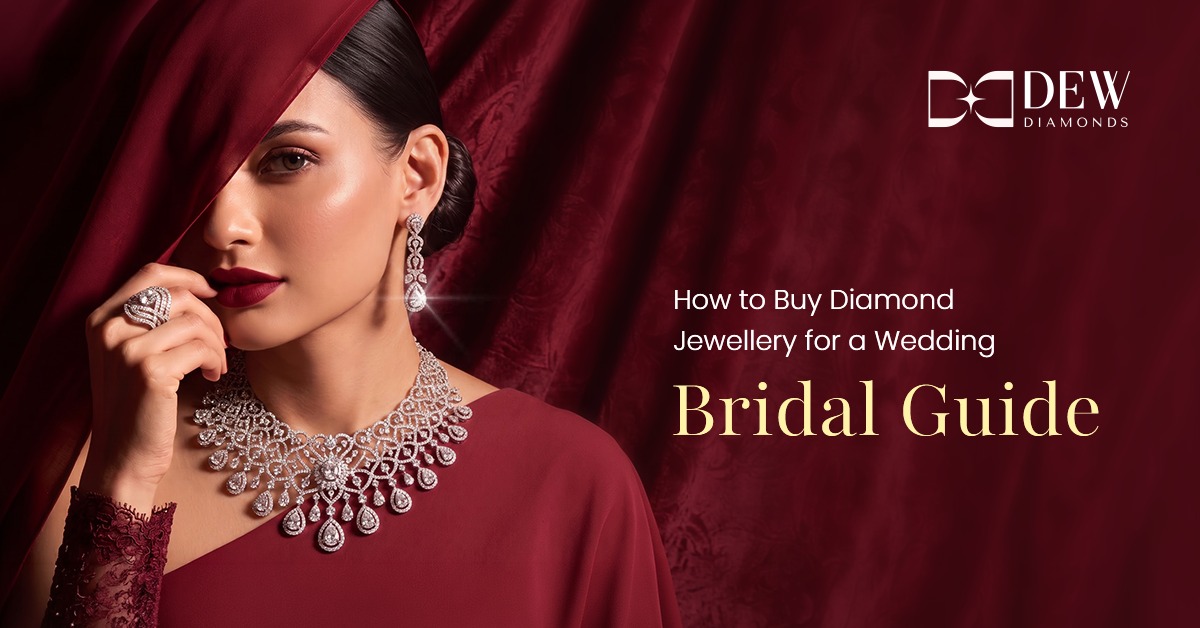
A bridal diamond jewellery set is a coordinated collection of diamond-studded pieces designed to create a unified bridal look. It may include a necklace and earrings, or a more extensive combination of necklace, earrings, ring, bangles, and other accessories.
Why Does a Matched Set Photograph Better Than Individual Pieces?
A coordinated set can create visual continuity across the entire bridal look. Matching or complementary motifs, metal tones and diamond styles help the jewellery look intentional from a distance and in photographs.
That does not mean every piece needs to be identical. In fact, mixing pieces with a common design language can look more contemporary. For example, a statement necklace can be paired with simpler earrings if the neckline and hairstyle already create visual interest around the face.
What Does a Complete Bridal Diamond Set Include?
There is no universal definition of a ‘complete’ bridal set. The pieces you need depend on your outfit, wedding customs, personal style and how much jewellery you intend to wear. A typical wedding diamond jewellery set may include:
| Piece | Purpose | Optional |
| Necklace (Choker / Haar) | Centrepiece of the bridal look | Usually essential for a traditional bridal look |
| Earrings | Frames the face and complements the necklace | Usually essential |
| Maang Tikka | Draws attention towards the face and hairline | Depends on personal and cultural preference |
| Bangles / Bracelet | Completes the wrist look | Depends on the outfit and tradition |
| Ring | Adds a personal or statement element | Often included, but not necessarily part of the set |
| Nath (Nose Ring) | Adds a regional or traditional element | Yes |
| Kamarbandh (Waist Belt) | Defines the silhouette over a saree or lehenga | Yes |
The distinction matters when shopping. You do not have to buy every possible piece simply because it is marketed as a bridal set. Start with the pieces that matter most to your ceremony and styling plans, then add accessories where they genuinely improve the overall look.
How Should You Choose Bridal Diamond Jewellery by Face Shape?
Your face shape can help you decide which proportions and silhouettes are most flattering. It is a styling guideline rather than a strict rule.
- Round Face
If your face has softer contours and similar width and length, elongated jewellery can create a sense of vertical balance. You can consider the following types:
- Long drop or dangler earrings
- Elongated pendant details
- Longer necklaces that create a vertical line
- Less emphasis on very wide, rounded designs close to the cheeks
- Oval Face
An oval face generally offers considerable flexibility because its proportions are naturally balanced. You can experiment with the following types.
- Studs
- Chandeliers
- Medium-to-long earrings
- Chokers
- Layered necklaces
- Statement tikka designs
Choose based on your hairstyle and neckline rather than trying to correct the face shape.
- Heart-Shaped Face
A heart-shaped face is typically broader around the forehead and narrower towards the chin. Jewellery with some volume towards the lower part can create balance. Try the following types:
- Teardrop earrings
- Pear-shaped diamond drops
- Medium-length necklaces
- Earrings that widen towards the bottom
- Square Face
Angular jawlines can be complemented by softer, curved jewellery silhouettes. Look for:
- Oval or rounded earrings
- Curved necklace patterns
- Drop earrings
- Designs with flowing rather than strongly geometric outlines
- Long Face
If your face is longer than it is wide, jewellery with horizontal or rounded proportions can add visual balance.
Consider the following types:
- Chokers
- Cluster earrings
- Shorter necklace styles
- Wider earrings rather than very long drops
Ultimately, the most important test is how the jewellery looks with your hairstyle, neckline and natural proportions. Face-shape guides should help narrow your options, not dictate them.
How Do You Match Bridal Jewellery to Your Outfit Neckline?
The necklace should work with the space created by your neckline rather than compete with it. Before choosing a necklace, try the jewellery with the actual blouse or lehenga neckline whenever possible.
| Outfit Neckline | Best Necklace Style |
| Deep V/Plunge | Long haar following the neckline |
| Sweetheart | Choker + mid-length combination |
| High Neck/Closed | Skip or minimise the necklace; focus on earrings and tikka |
| Off-Shoulder | Choker or collar necklace |
| Round/Boat Neck | Fitted choker sitting above the neckline |
For a deep V neckline, a long necklace can follow the natural line of the outfit. A sweetheart neckline gives you more room to layer a choker with a longer necklace. With a high or heavily embellished neckline, adding another large necklace may make the upper half of the outfit look crowded.
Also consider the dupatta placement. If it will sit across your chest or over one shoulder, a heavily layered necklace may disappear beneath it.
How Should You Choose Bridal Jewellery by Lehenga Colour?
The colour of your outfit can influence your choice of metal, diamond setting and overall jewellery aesthetic. Here is a useful starting point.
Red, Maroon and Rani Pink
These rich bridal colours traditionally work beautifully with yellow gold, particularly when the embroidery also contains warm metallic details. For a contemporary interpretation, white gold can create a sharper contrast against deeper reds and pinks.
Pastels: Blush, Ivory and Lavender
Pastel outfits pair naturally with lighter-looking metals. Consider these options:
- White gold for a crisp, contemporary finish
- Rose gold for a softer tonal effect
- Diamonds with delicate, less-heavy settings
Rose gold can complement blush and dusty pink particularly well, while white gold can provide contrast against ivory.
Deep Jewel Tones: Emerald, Navy and Wine
Deep colours provide an excellent backdrop for bright diamonds. White gold and platinum can create a clean contrast, while yellow gold gives the combination a richer, more traditional appearance.
Gold and Ivory Outfits
When your lehenga already contains substantial gold embroidery, yellow-gold jewellery can create a seamless traditional look. If you want the diamonds to stand out more distinctly, white gold or platinum can provide contrast. Before deciding, look at the actual embroidery thread, embellishments and blouse rather than relying only on the base colour of the lehenga.
Which Metal is Best for Bridal Diamond Jewellery?
The right metal depends on your outfit, existing jewellery and the overall aesthetic you want.
| Metal | Ideal for | Style Signal |
| Yellow Gold (18K) | Traditional lehengas and warm-toned styling | Regal, classic |
| White Gold (18K) | Contemporary diamond jewellery | Modern, crisp |
| Rose Gold (18K) | Blush and pastel outfits | Soft, romantic |
| Platinum | Minimalist and premium looks | Sleek, understated |
One important point: metal choice is not simply a question of which colour looks better. Consider durability, maintenance, existing jewellery and how frequently you plan to wear the piece.
Diamond Shapes Popular in Bridal Jewellery
The shape of a diamond influences the overall character of a jewellery piece, from the intense sparkle of a round brilliant to the clean, architectural look of an emerald cut. For bridal jewellery, the right choice depends on the design, setting and look you want to create. Here are some popular diamond shapes to consider for your bridal look:
Round Brilliant: Maximum Sparkle
Round brilliant diamonds are a classic choice for bridal jewellery when sparkle is the priority. Their carefully designed facet arrangement is intended to maximise brilliance and light return, making them particularly versatile for earrings, necklaces, rings and pendants.
Their classic outline also makes them easy to pair with other diamond shapes. A round brilliant centre stone can, for instance, be surrounded by smaller round diamonds or combined with pear-shaped or baguette accents for a more distinctive design.
For a bride who wants a timeless look that will remain easy to style beyond the wedding, round brilliant is one of the safest choices.
Oval: Elegant & Contemporary
Oval diamonds use a brilliant-style faceting pattern, giving them strong brilliance while their elongated outline creates a different visual proportion from a round brilliant.
In bridal jewellery, oval diamonds can work particularly well as centre stones, pendant details and statement earrings. They are a good option when you want something familiar but slightly less conventional than a round diamond.
Cushion: Vintage Romance
Cushion diamonds have a square or rectangular outline with rounded corners, giving them a softer, vintage-inspired appearance than sharply edged geometric shapes. They work particularly well in statement rings, pendants and centrepiece jewellery where the stone needs to have a noticeable presence without looking overly sharp or contemporary.
If your bridal look draws from vintage motifs, intricate embroidery or heirloom-inspired styling, a cushion shape can fit naturally into the aesthetic.
Pear: Beautiful in Drops and Tikkas
With one rounded end and one pointed end, the pear shape has an instantly recognisable teardrop silhouette. Its directional shape makes it especially effective in earrings, pendants and maang tikkas.
Pear-shaped diamonds are also useful when you want to introduce movement into a jewellery design. A pair of pear-shaped drops can frame the face, while a pear-shaped centre element can give a tikka or pendant a graceful focal point.
Because of its pointed tip, the setting deserves particular attention. The point should be adequately protected by the design and setting rather than left unnecessarily exposed.
Emerald Cut: Understated Luxury
Emerald-cut diamonds take a different approach to sparkle. Their step-cut facets create broader, mirror-like flashes rather than the intense scintillation associated with brilliant cuts. They are therefore appreciated more for their clean lines, clarity and sophisticated appearance than for maximum sparkle.
In bridal jewellery, an emerald-cut diamond can bring a refined, modern quality to a necklace, ring or statement earring. It is particularly suited to brides who prefer jewellery that feels elegant without being excessively ornate.
How Should You Set a Bridal Jewellery Budget?
The best way to budget for bridal diamond jewellery is to decide what you want to wear on the wedding day and what you would realistically wear afterwards. Instead of allocating your entire budget to one elaborate set, divide it according to both immediate importance and long-term use.
The 80/20 Rule: Wedding Set vs Re-Wearable Pieces
An 80/20 split can be a useful planning framework, rather than a hard financial rule.
For example, if your total jewellery budget is ₹4 lakh, you could consider allocating approximately:
- ₹3.2 lakh towards the main wedding combination
- ₹80,000 towards pieces selected specifically for future wear
The idea is simple: do not put your entire budget into one spectacular bridal necklace if it is unlikely to leave the wedding wardrobe. A versatile pair of earrings, ring or bracelet may deliver more value over time.
Budget Range Guide for India
There is no fixed price range for bridal diamond jewellery. The amount you need depends on the type and number of pieces you choose, the diamond specifications, total carat weight, metal, design complexity and craftsmanship. Instead of following a standard price bracket, set your budget around the pieces that matter most to your wedding look.
- Prioritise key pieces: Decide whether the necklace, earrings, ring or another piece will be the main investment.
- Consider future wear: If you want jewellery that you can use after the wedding, allocate part of your budget to versatile pieces that work with other outfits.
- Compare specifications: Look beyond the overall price and compare the diamond characteristics, total carat weight, metal purity and design across pieces.
- Keep additional costs in mind: Factor in customisation, alterations and any other applicable charges when setting your final budget.
Diamond jewellery prices can vary considerably even between pieces with similar designs or total carat weights. This is why comparing the specifications and overall design is more useful than relying on a broad price category alone.
Why Certification Should Never Be Compromised for Budget
If you are spending a substantial amount on diamonds, documentation should be part of the buying decision and not an afterthought.
A diamond grading report records characteristics such as colour, clarity, cut and carat weight, depending on the type of report. GIA and IGI, for example, provide diamond reports and verification systems; IGI reports can also identify whether a diamond is natural or laboratory-grown.
For a bridal purchase, ask exactly what is certified, by whom and what information the report covers. A jeweller’s product invoice and a diamond grading report serve different purposes.
Diamond Bridal Jewellery vs. Traditional Gold Jewellery
The choice does not have to be one or the other. Many Indian brides combine gold and diamond jewellery to create a look that feels both traditional and contemporary.
| Factor | Diamond Bridal Jewellery | Traditional Gold Jewellery |
| Design versatility | Often offers contemporary and versatile styling | Often features traditional and heritage-inspired designs |
| Outfit Pairing | Can work with Indian and Western outfits | Often associated with Indian and traditional outfits |
| Weight & Comfort | Depends on design, metal weight and stone coverage | Depends on design, metal weight and stone coverage |
| Documentation | Diamond grading report; metal hallmark where applicable | Gold hallmark where applicable |
| Best For | Brides seeking diamond-led or contemporary styling | Brides seeking traditional or heritage-inspired styling |
Common Mistakes to Avoid When Buying Bridal Jewellery
A beautiful piece can still be the wrong bridal purchase if it does not work with your actual wedding plans. Here are some common mistakes to avoid when purchasing bridal jewellery:
- Buying Jewellery Before Finalising the Outfit : Your neckline, embroidery, blouse design and dupatta placement all influence which jewellery will work. Finalise the major outfit details before committing to a large necklace.
- Skipping Certification : Do not judge diamond quality by sparkle alone. Ask for the relevant documentation and verify the report where possible. GIA and IGI both provide report-verification services.
- Ignoring Comfort for Full-Day Wear : Wedding jewellery may stay on for hours through ceremonies, photographs, greetings and celebrations. Check for factors such as earring weight, necklace fit, clasp security, bangle movement, and sharp or exposed edges.
- Leaving Shopping Until the Last Minute : Custom designs, size adjustments and production can take time, particularly for personalised or made-to-order jewellery. Start shopping well in advance, so you have enough time to finalise your choices, make any necessary adjustments and have the jewellery ready before the wedding.
Checklist Before Buying Bridal Diamond Jewellery
Before paying for your jewellery, run through this complete checklist to ensure you have made the right choice:
Design & Styling
- Wedding outfit and neckline are finalised
- Jewellery works with the blouse and dupatta
- Metal colour complements the outfit
- Necklace and earrings are proportionate
- Jewellery suits the planned hairstyle
- Traditional pieces such as a nath or maang tikka are included only if wanted
Diamond Quality
- Diamond shape and size suit the design
- 4Cs have been explained clearly
- Relevant grading documentation is available
- Natural vs laboratory-grown diamond status is clear
- Report details can be verified where applicable
Metal & Craftsmanship
- Gold karatage is clearly stated
- BIS hallmark/HUID is checked where applicable
- Setting and clasps have been inspected
- Finish is clean and secure
Purchase Details
- Final price is confirmed
- Diamond and metal specifications are documented
- Invoice is provided
- Return/exchange terms are understood
- Resizing or alteration options are confirmed
- Delivery date leaves enough time before the wedding
A good purchase should leave you with clarity about what you bought, what it is made from and how it has been graded.
How Should You Care for Your Bridal Diamond Jewellery?
Good care starts immediately after the wedding. Diamonds are durable, but the jewellery surrounding them still needs protection from knocks, chemicals and everyday wear.
- Store pieces separately: Keep necklaces, earrings, rings and bangles in individual soft-lined compartments where possible to reduce scratching and tangling.
- Keep jewellery away from chemicals: Perfume, hairspray, cosmetics and household cleaning products can affect metals or leave residue on jewellery.
- Put jewellery on last: Complete makeup, skincare and fragrance before wearing your diamonds.
- Remove jewellery during strenuous activities: Avoid wearing pieces where they may be exposed to impact, abrasion or unnecessary stress.
- Check settings periodically: Prongs, clasps and other settings should be examined for signs of loosening.
- Clean carefully: Follow the jeweller’s care instructions for the specific metal and setting rather than using an aggressive household cleaner.
- Use professional inspection when needed: If a stone appears loose or a setting is damaged, have it examined rather than continuing to wear it.
Find Your Bridal Sparkle with Dew Diamonds
Buying bridal diamond jewellery is easier when you look at the complete picture. Consider your outfit, neckline, face shape, and lehenga colour, then choose the diamond shapes and metal that complement them. Keep other factors like your budget, certification, and comfort in mind as well. Moreover, if you want to wear your jewellery beyond the wedding, choose pieces that work just as well with your future looks.
At Dew Diamonds, every piece is created with a focus on quality, responsible sourcing and careful craftsmanship. With 14+ years of experience and a team of 300+ professionals, Dew Diamonds brings expertise to every stage of diamond jewellery manufacturing. Whether you are looking for a classic bridal set or something made to your preferences, the focus remains on creating jewellery you can feel confident wearing on your most important occasions.