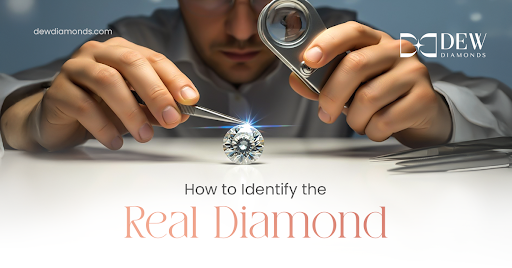
How to Identify the Real Diamond
Diamonds have always been seen as a luxury item, rare, and valuable. People have loved them for ages. Because they’re so popular, there are lots of fake ones out there, and they can fool you even if you’re careful. Some stones, like moissanite and white sapphire, look so much like diamonds that it’s tough to tell them apart.
It’s really important to know how to identify a real diamond now, since fake diamonds look more and more real because of new technology. Whether you’re buying a diamond ring or wondering if a piece of jewellery you have is real, knowing how to tell a real diamond protects you from wasting money.
The good news is, you don’t always need special tools to tell if a diamond is real. You can do some tests at home, but it’s best to have a professional do the other ones. Doing a few tests together will give you a pretty good idea if the stone is real or just a good fake.
How to Differentiate Real and Fake Diamonds
You can find all kinds of stones in jewellery stores, like cubic zirconia, moissanite, white sapphire, and lab-grown stones. Some of these are worth something, but they’re not the same as real diamonds. They don’t react the same way to light, heat, or pressure. If you know what makes diamonds special, you can tell them apart from fakes.
People love diamonds because of their high refractive index, dispersion, and hardness. These things give diamonds their amazing sparkle and fire. Usually, they look clear or see-through, and they can be cut and polished into exact shapes. Most diamonds are white or yellow. But the rare ones? They can be blue, green, pink, or even red.
A helpful framework is the Four Cs of diamond grading:
- Colour: Ranges from D (no colour) to Z (light yellow/brown). Natural diamonds show subtle colour nuances that many fakes lack.
- Cut: Evaluates proportions, symmetry, and polish. Properly cut diamonds reflect light to produce the characteristic sparkle, whereas imitations may appear dull or unnaturally rainbow-like.
- Clarity: Measures internal inclusions and surface blemishes, graded from Flawless to Included.
- Carat Weight: Refers to weight rather than size (1 carat = 0.2 g). Some imitations, like cubic zirconia, can be heavier than diamonds of equal dimensions.
Here’s how to tell real diamonds apart:
- How it handles light: A real diamond will bend and spread light to make it sparkle. Fakes usually look flat, like glass, or have too many rainbow colours.
- How tough it is: A diamond is the hardest known natural material on Earth, so it doesn’t scratch easily. Most fakes will show scratches over time.
- How it handles heat: Diamonds get rid of heat fast, but many fakes hold onto heat or might even break if the temperature changes suddenly.
- How heavy it is and how it looks: Fakes might feel heavier or seem too perfect. Real diamonds usually have tiny marks or differences that show they are natural.
Understanding these traits alongside the Four Cs equips you to differentiate real diamonds from imitations and prepares you for more precise testing methods.
Testing Methods of Diamonds
These are some common and reliable ways to see if a stone is a real diamond. You can do some of these tests at home, but others are better left to experts.
1. Water Test
This is one of the simplest checks for diamond identification. Fill a glass with water and drop the stone in. If it’s a real diamond, it’ll sink right to the bottom because it’s really dense. Many imitation stones, especially glass, will float or fall slowly.
It’s important to note that this method only works with loose diamonds. Any stone set in a ring or other jewellery piece cannot be accurately tested, as the surrounding metal adds weight and affects the result. This test isn’t perfect, but it can give you a fast first indication.
2. Fog Test
Hold the stone between two fingers and gently exhale on it, as if fogging a mirror. A real diamond disperses heat rapidly. The fog will vanish almost instantly. A fake stone stays foggy for a few seconds because it doesn’t conduct heat as quickly.
This test works well with both loose stones and those set in jewellery.
There’s no universal “fog time” to rely on, and factors like room temperature or humidity can easily influence what you see. If possible, compare the reaction of a diamond you already know is genuine with the stone you’re testing. It gives you a more reliable point of reference.
3. Use Direct Sunlight
A quick way to check a diamond is to see how it reacts in natural sunlight. Real diamonds give off bright white flashes mixed with subtle rainbow sparkles, creating a lively, sharp shine. Fake stones usually look flat or overly glassy in comparison.
For a closer look, grab a loupe or magnifying glass. Real diamonds usually have tiny natural inclusions, while most fake stones appear too perfect. Sunlight can’t do what a professional test can, but it’s an easy way to see obvious differences right away.
4. Scratch Test
One easy way to see if a diamond could be real is the scratch test you can do at home. Because diamonds are super hard, they shouldn’t scratch easily.
To try it, gently scratch the surface of a glass or ceramic plate with the stone. If you scratch a real diamond against something, it’ll leave a mark, but the diamond itself will be fine. But fake diamonds are soft, so they’ll probably get scratched in the process.
While this method gives a quick indication, it’s not foolproof, and you should be careful to avoid damaging softer imitation stones. Even so, it’s an easy way to spot obvious differences in hardness.
5. Magnetic Test
Diamonds are not magnetic. So, if you hold a magnet near the stone and it moves, gets pulled in, or spins around, chances are it’s not a real diamond.
Some imitation stones contain metallic elements or impurities that respond to magnets. Keep in mind that while this test won’t tell you for sure if a diamond is real, it can tell you right away if it’s a fake.
6. Refractive Index Test
Real diamonds bend light so strongly that it’s tough to see through them. But fake ones usually let light go straight through. You can do two quick tests at home to see what your stone does with light.
Newspaper Test:
Place the diamond upside down on the printed text. If you can read the letters clearly, it’s likely not a real diamond. Genuine diamonds scatter light enough to blur or hide the print, except in cases of poor cuts.
Dot Test:
Draw a small dot on white paper and set the diamond over it. If the dot disappears when you look through the stone, that’s a good sign. If you can see the dot or its outline, the stone is probably an imitation. These tests aren’t a substitute for an expert’s opinion, but they’re a fast way to check how well your diamond bends light.
7. Thermal Conductivity Test
Diamonds are excellent at carrying heat, and this property makes thermal testing a quick way to check if a stone might be real. Jewellers often use a thermal conductivity meter, commonly known as a diamond tester, to measure how fast heat moves through the gem.
When the probe touches the stone:
- Real diamonds transfer heat almost instantly.
- Most fake stones struggle to conduct heat at the same speed, and so they usually won’t pass the test.
This procedure isn’t a perfect method, but it’s a quick and popular way to see if your stone might be a real diamond.
8. Ultraviolet Test
Using a black light, or UV light, is an easy way to check if a diamond is real. When exposed to UV light, many real diamonds exhibit a faint glow, a phenomenon known as fluorescence.
Around 25–35% of natural diamonds glow blue under UV light, though in rare cases, they can show hints of yellow, green, or orange.
While a blue glow suggests authenticity, its absence or a different colour doesn’t automatically mean the stone is fake. So, it’s best to get it checked out by an expert.
Professional Certification
The most reliable way to confirm authenticity is through professional diamond certification. Reputable jewellers and gemological laboratories issue detailed reports that identify whether a diamond is natural, lab-grown, or synthetic.
Trusted certification bodies include:
- GIA (Gemological Institute of America)
- IGI (International Gemological Institute)
- SGL (Solitaire Gemological Laboratories)
A certified diamond comes with documentation listing its cut, clarity, colour, carat weight, and verification of authenticity. This is especially crucial when buying high-value jewellery.
Conclusion
Understanding how to identify a diamond gives you the confidence to make informed decisions. Simple tests you can do at home, like the fog and sunlight tests, give you fast hints. Still, it’s best to use these together with more detailed diamond identification techniques, like looking at how it bends light or how well it carries heat.
No matter how good those home tests are, nothing beats getting a professional’s assessment. Getting certification from a trusted gemological laboratory ensures that the diamond you buy is beautiful, genuine, and will retain its value for years to come.